


Building Rebecca Camille
Rebecca Camille was built as more than a website.
It was built around how I wanted to help businesses connect the paths within their business, look beyond the conventional, and explore possibilities they may not have considered.
The site was designed to bring that approach and the Accel Game Plan Methodology to life.
What began as visual elements within the site would eventually become something much larger, creating a growing library of content connectivity throughout Rebecca Camille.
Built to eliminate endless back-and-forth scrolling, these interconnected paths created a highway.
Following one path can lead to another, and you may never make it to the bottom of the page you started on.
This case study tells the story of how those connections came to be.
The Build in Stages
Rebecca Camille began with a blank slate.
I explored templates first, but found them too generic for what I wanted to build. I wanted control over the site's structure, navigation, connections between pages, and the underlying schema markup.
Building from a blank canvas gave me the freedom to let the site develop around the business rather than fit the business into a predetermined design.
I also wanted to use my own photography. As I searched through my collection of photographs from exploring the Mojave Desert, I began to see a parallel between the landscape I knew so well and the business site I was building.
The images began to tell a story that felt remarkably connected to the way I wanted to explore a business.
There were paths leading somewhere and trails that disappeared. Open expanses offered a wider view, hidden mines suggested what could exist beneath the surface, and changing terrain required a change in direction.
The Mojave Desert wasn't chosen as a theme for Rebecca Camille. It revealed itself as a way to tell the story.
You're standing inside the result of the case study you're about to explore.
THE GUIDING LIGHT APPEARS
When the footer was built, the lantern was placed beside "Whenever you're ready, the trail begins here." and became the guiding light to The Path. It later found its way into Rebecca Camille's Open Graph imagery.
Finding the Colors in the Desert
Early in the build, I wanted to use gold as an accent color. I tried at least a dozen different shades before choosing one that worked well enough to keep moving.
Later, as I began choosing photographs from my Mojave Desert collection for the site, I realized the images held the richer colors I had been looking for all along.
I began pulling colors directly from the photographs.
The yellows within a flowering desert bush gave me Desert Bloom Gold, Sunflare Amber, and Morning Horizon.
That discovery became the beginning of the Accel Game Plan Methodology Found Desert Palette.
Five Stages Took Shape
As the Accel Game Plan took shape, the five stages became Clarify, Analyze, Strategize, Implement, and Accelerate.
Each represented a different part of the process I wanted to use when exploring a business: first gaining clarity, then looking deeper, determining a direction, putting that direction into motion, and continuing forward.
I wanted each stage to have its own visual identity, something that could represent its place within the Methodology while still connecting the five stages as one process.
That idea became the five medallions.
Before the Mojave
Clarify and Analyze were the first two Accel Game Plan medallions.
Their original designs used familiar visual representations of business discovery and analysis: magnification, checklists, charts, data, and a destination ahead.
They represented the purpose of each stage, but they hadn't yet found the visual language that would become Rebecca Camille.


Strategize Changed the Direction
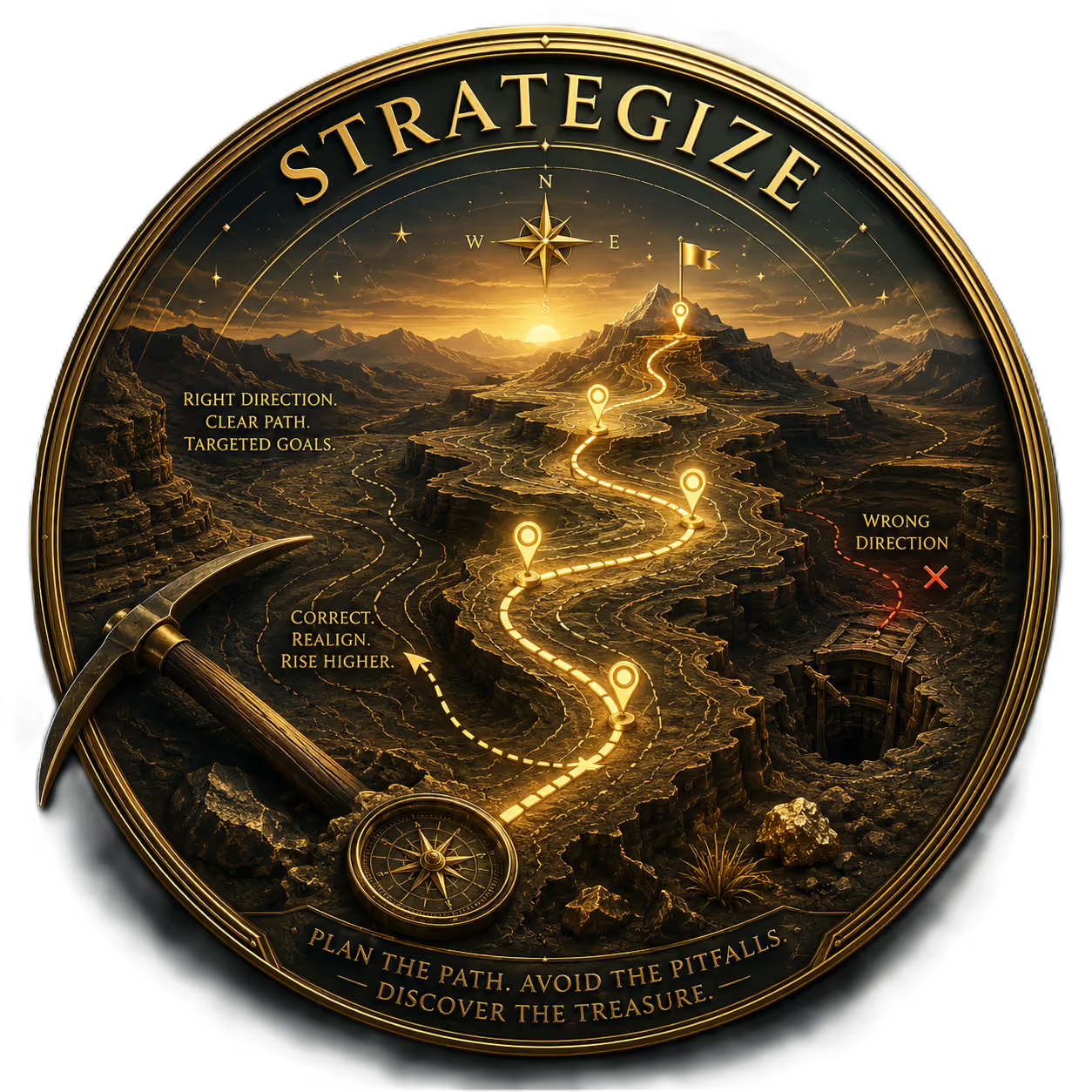
When it came time to design Strategize, I thought about the way I explored the desert when treasure hunting.
The ultimate goal was to find gold and perhaps discover a place where I could stake a claim of my own.
Before heading out, I used Google Earth Pro to study the washes, locate old mines, map possible routes, and determine how I could reach the areas I wanted to explore.
There was always a destination in mind, but how far I could go depended on the resources and equipment available, the conditions I might encounter, and what the terrain required along the way.
Once I was on the ground, the map was only the beginning.
Ravines, changing terrain, sedimentary layers, an old mercury mine, or simply discovering that a path was taking me in the wrong direction could change the plan. I began to see how closely that process paralleled strategic planning in a business.
A business can identify where it wants to go and map a path toward it, but strategy also means paying attention to what is discovered along the way.
New information can reveal an opportunity, expose an obstacle, or show that the current path is no longer leading toward the intended goal.
Sometimes moving forward requires changing direction. That became the foundation for the Strategize medallion.
I envisioned it almost as a treasure map: paths moving through the terrain, markers identifying points along the way, a compass for direction, and a pickaxe representing the need to dig deeper into what might not be visible from the surface.
Strategize became the first medallion built around the Mojave Desert, and a new direction for the Accel Game Plan visual language was born.
The Series Takes Shape
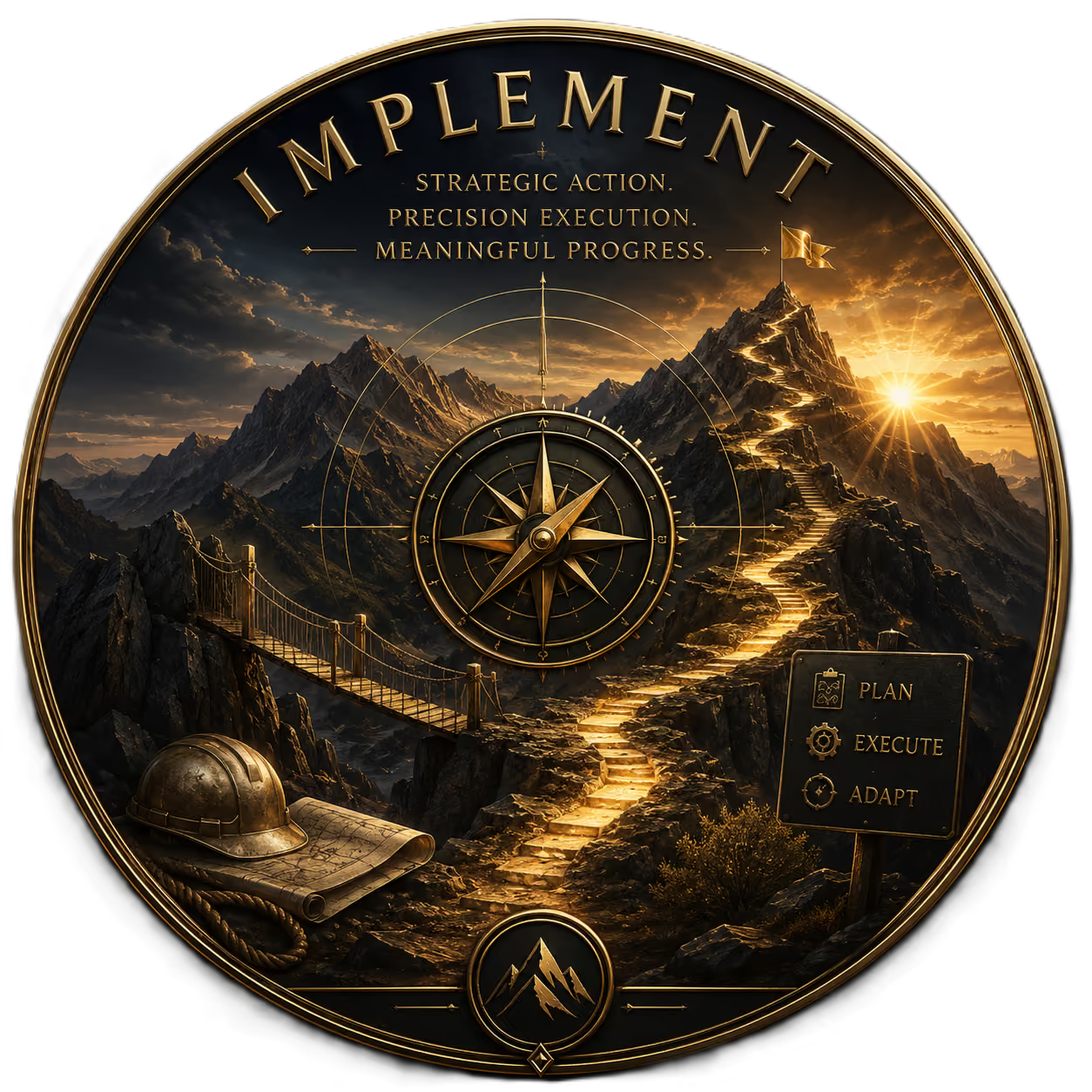
With the visual direction established, I continued forward with Implement and Accelerate.
Both were designed around the Mojave landscape, but each developed its own imagery around the role it represented within the Accel Game Plan.
For the first time, the medallions were beginning to look like they belonged to the same world.

Clarify and Analyze Are Reimagined
With the visual language now established, I returned to Clarify and Analyze and redesigned them around the Mojave landscape.
They still needed to represent the purpose of their stages, but now they also needed to belong to the same world as Strategize, Implement, and Accelerate.
Clarify Finds Its Landscape
Clarify was the first medallion I returned to.
The original design represented the process of gaining clarity, but I wanted the new medallion to express what clarity could feel like rather than simply illustrate the tools used to find it.
The Mojave offered that perspective in its open expanses.
Standing where the landscape opens in front of you changes what you can see.
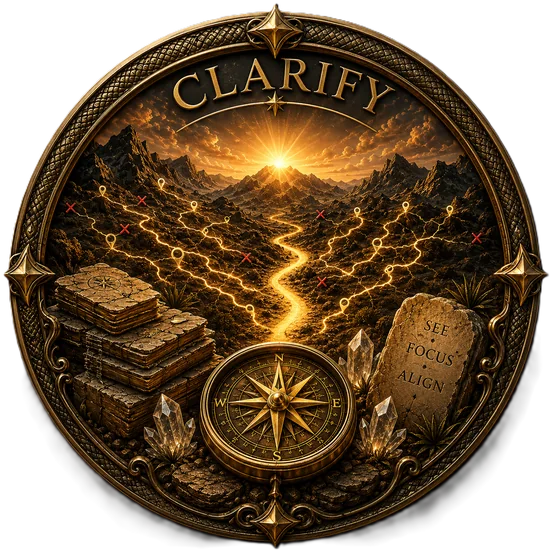
The open expanse represents the breathing room to focus entirely on Clarify, looking across the business as a whole, considering its assets and how they interconnect, and recognizing the paths being followed, those that have led astray, and those still waiting to be explored.
That became the foundation for the redesigned Clarify medallion: a wider view, an opening landscape, and the possibility of seeing a path that wasn't visible before.
Analyze Looks Beneath the Surface
Analyze was next.
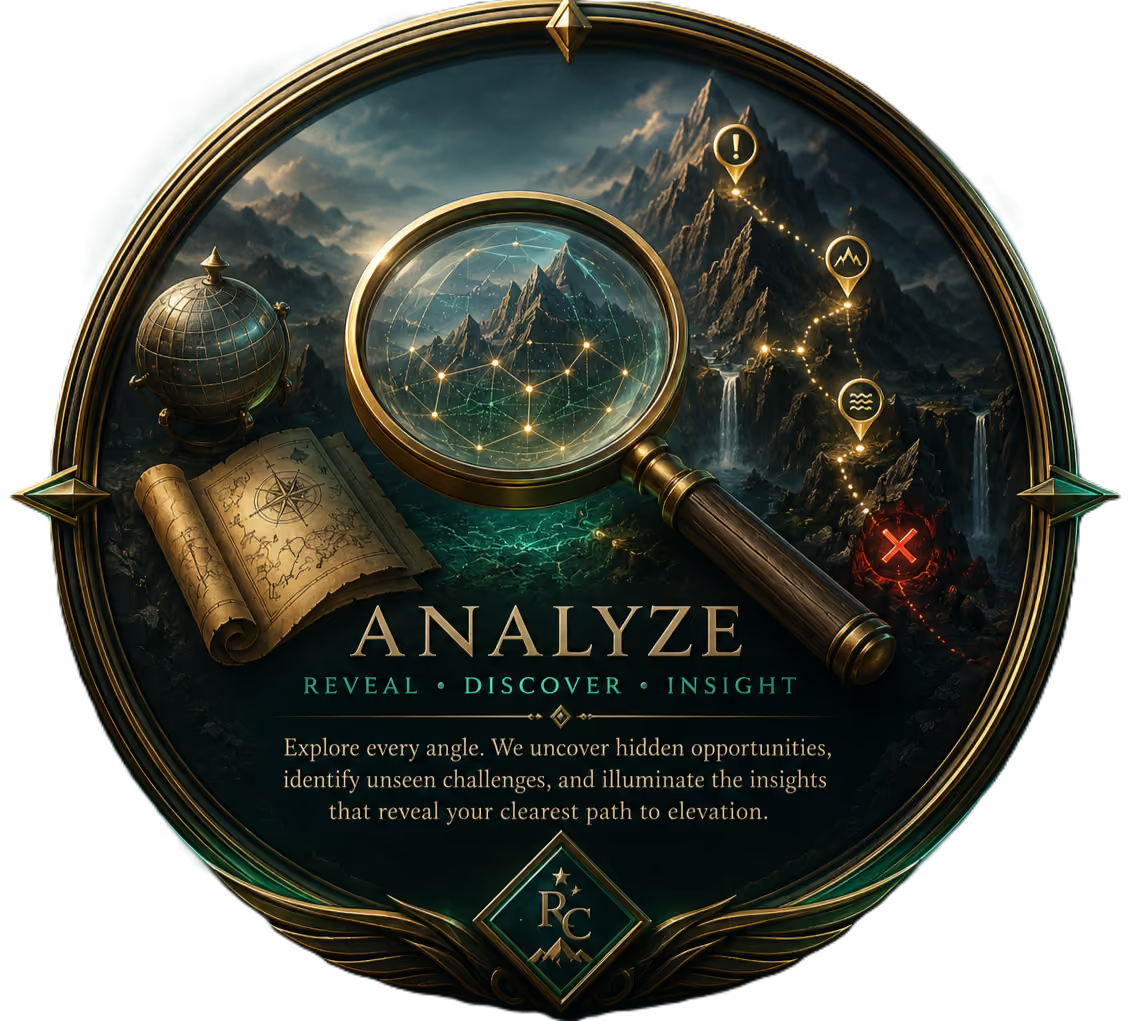
The original medallion used charts and data to represent analysis. But the Mojave had taught me that collecting information and understanding what you've found are not necessarily the same thing.
While treasure hunting, I once found a piece of quartz that contained gold without realizing what I had discovered. It wasn't until I took it to a rock shop that I understood what I had been looking at.
I also brought home bags of rocks and sand to dry pan, following the possibility that they might contain something worth finding. Sometimes what caught my attention turned out to be pyrite.
Both experiences required looking beyond the initial impression to understand what was actually there.
The Medallions Become Playbooks
As I added the desert imagery and content to the Methodology page, another connection began to emerge.
The individual symbols within the five medallions could represent more than their place within the landscape.
Each could also be defined by how it relates to different aspects of a business.
That connection became the idea behind the Playbooks.
Each Playbook breaks its medallion down into the individual symbols it holds and explores how each one can relate to a business.
Together, the five Playbooks give visitors another way to explore the Accel Game Plan Methodology and perhaps have an aha moment about something within their own business they hadn't considered before.
43 symbols across five Playbooks: Clarify 7 · Analyze 8 · Strategize 10 · Implement 9 · Accelerate 9
Connecting the Playbooks to the Methodology
The Methodology page had developed into 15 sections, each exploring a different part of Clarify, Analyze, Strategize, Implement, or Accelerate.
As the Playbooks took shape, the symbols could be connected directly to the Methodology sections where their meaning came into play.
Those connections created paths in both directions. A visitor reading the Methodology can follow a linked symbol into its Playbook to explore it more closely.
Once there, two navigation rails give them a choice in how they continue.
The Methodology rail provides a path back to the section they came from, allowing them to continue through the Methodology page.
The Symbol Guide rail lets them move among the individual symbols within that Playbook. Because the Playbooks are long, selecting a symbol automatically brings its section into view between the stationary rails, giving visitors direct access to any symbol without having to scroll up or down the page to find it.
Building the rails also revealed something I hadn't anticipated.
Their ability to remain stationary wasn't controlled by the rails alone.
The surrounding page structure determined whether they could hold their position while the content moved between them. What first appeared to be a problem with the navigation itself sometimes meant looking beyond it to find what was actually affecting its behavior.
The visitor doesn't have to follow one predetermined path.
They can move between the Methodology and Playbooks as their own exploration unfolds.
Navigating the Paths
As Rebecca Camille grew, additional paths connected the Methodology, Playbooks, and Clarify Assessment Findings, allowing visitors to follow an idea from one part of the site to another.
Path to RC Findings

Path to Playbook Symbols

Path to Methodology
The Navigation Rails in Action
The Strategize Playbook navigation rails are shown below as a working example of the system.
Strategize was chosen because it marked the turning point in the medallion design and, with ten symbols, provides a fuller view of the Symbol Guide rail.
The Methodology rail provides a path back to the Methodology page and its 15 sections. Each Playbook lists only the Methodology sections related to its medallion, identified by section number and name, allowing a visitor to return directly to the section they came from.
It also provides a path back to the Clarify Assessment Findings page and its 9 sections, along with access to the other Playbooks. The Playbook currently being explored isn't listed because the visitor is already there.
Open either rail to explore how the paths work.
Built For Exploration
Rebecca Camille.com